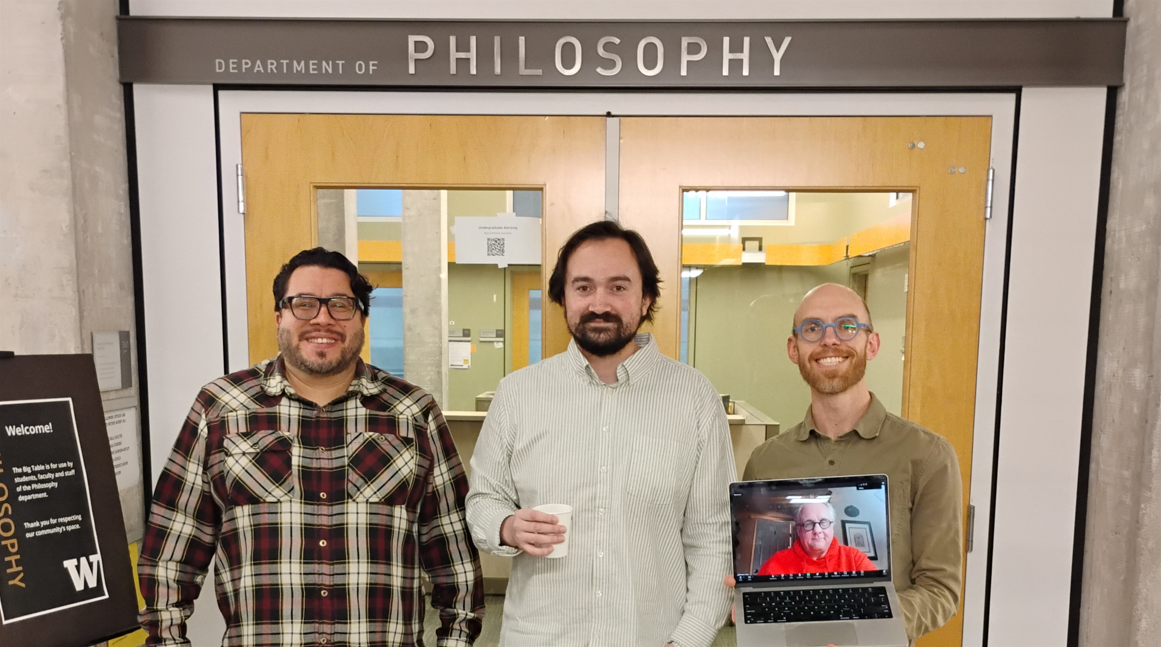
Earlier this month on February 13, 2026, Philosophy Graduate Student Daniel Galley successfully defended his dissertation titled: "The Ethics of Persuasion". He was overseen by a committee consisting of Philosophy faculty members Michael Blake, Colin Marshall, and José Mendoza.
In this dissertation, I use ‘persuasion’ to refer to the provision of reasons offered with the intention of changing the target’s mind on some moral matter. A key premise that underlies much of this dissertation is that engaging others in persuasion constitutes an essential way of recognizing their rational agency. This dissertation consists of three papers, all of which focus on the ethics of persuasion. In the first paper, I argue that we have a prima facie moral obligation to not forgo persuading others out of distrust in their rational capacity to sincerely engage with moral reasons, since doing so treats them paternalistically. The second paper responds to the claim that attempts at persuasion can risk precluding the target from exercising their rational autonomy by getting the target to defer to the persuader’s judgment. I argue that while attempts at persuasion can result in the target deferring to the persuader’s judgment, the attempt at persuasion does not risk precluding the target from exercising rational autonomy, but rather the attempt risks expressing an ‘authoritative air.’ In the third paper, I make a contribution to a recent argument made by Cecile Fabre (2023), who claims victims of wrongdoings have a pro tanto moral duty to accept their wrongdoer’s apology. I begin by identifying a category of wrongdoing that I refer to as ‘complex wrongdoings’, that fall outside of Fabre’s duty to accept apologies. I argue that while the victim is under no duty to accept the wrongdoer’s apology in these cases, the victim can still have a moral duty to sincerely engage with the wrongdoer’s apology as a form of persuasion.
We are all proud of Dr. Galley and are excited to see all his future accomplishments.
Congrats Daniel!