
Philosophy graduate students have been busy this year! They've published and co-written articles, won prizes and awards, been nominated to positions and invited to present at international seminars. Congrats, awesome grad students!
Here are some highlights of their achievements:
Publications
Nicolai Wohns had an article published in the AMA Journal of Ethics, along with editing the issue as an editorial fellow. The abstract for his article is as follows: "Advances in public health, medicine, and technology since the mid-19th century have redefined what is considered “natural” for human beings. This article situates contemporary geroscience in that historical context. The development of gerotherapies must be guided by historical insight, ethical foresight, and a commitment to justice. Since extending lifespans has important societal consequences, how aging research will affect future generations should be prioritized. Equitable access to gerotherapies, as well as an emphasis on social responsibility and the influence of community on health and longevity, must remain central to any vision of the future of aging." See the Dec 2025 issue of the AMA Journal of Ethics and Nicolai's article.
Julia Pelger co-authored a paper and a response to it in Philosophy and Technology Issue 39. The abstract for the article is: "Technological objects have become world objects which becomes increasingly apparent by their different impacts on the global natural environment culminating in current natural crises. We argue that the philosophy of technology, due to its empirical turn to concrete technological objects, cannot provide the necessary conceptual tools to account for these natural impacts and the different uncertainties this creates. In this paper we give an account of this shortcoming of the philosophy of technology by giving an account of the relation between this philosophy and extractivism; the exponential acceleration of extracting natural resources to develop technological objects. Hence, we make the case that extractivism is an environmental-social condition of the possibility for technological objects to come into existence. We do this by carrying out a scale critique of the philosophy of technology, specifically the empirical turn, from its focus on concrete technological objects to the global environmental-social context in which they arise. We lay bare the occluding mechanisms within the political-economy of extractivism and the empirical turn that blind the philosophy of technology for extractivism. As a consequence, the philosophy of technology needs to be broadened, which we do by relying on Māori philosophy, specifically its relational and broader conceptions of time and space. By doing so, we provide the philosophy of technology with conceptual tools to account for extractivism and provide fruitful ground to develop conceptions of technological objects that benefit all, human and non-human, and everything." See Julia's article.
Jesus Raya co-wrote an article with Grecia Sanchez titled “SMAP Summer Institute: Celebrating 10 Years of Encuentros and Engagement” which was featured in the APA Studies on Hispanic/Latino Issues in Philosophy, Volume 25 number 1 (Fall 2025). This article was not a philosophy paper in the traditional sense. It was a report meant to share and celebrate their experience at the Society for Mexican American Philosophy’s (SMAP) first biannual summer institute with the broader philosophical community. As explained by the editor, Lori Gallegos, this “report offers readers an inside look at the ideas that were circulating at the institute, both in the academic talks and in the workshops. It also gives them a sense of what it was like to be a participant in the SMAP Summer Institute.” APA Studies-Hispanic/Latino Issues in Philosophy - Fall 2025.
Kai Clement-Milanovich published an article in the Sage Journals titled: "On Power and Measurement Systems: Feminist Standpoint Empiricism and the Sexual Experiences Survey." Philosophy of the Social Sciences (2025). The abstract reads: "This article examines the development of Mary Koss’s influential Sexual Experiences Survey and defends her then-controversial interpretive choice to endorse a broad-scope definition of rape. Koss’s choice was informed by an empirical recognition of how unjust power dynamics could confound measurement strategies. By adopting a feminist standpoint, Koss and her colleagues recognized how many measurement procedures implicitly disempowered respondents’ capacity to express inquiry-relevant data. Ultimately, the iterative development of a valid and reliable measurement system is compatible with, and quite comparable to, the feminist project of identifying how gendered relations of power enable the persistence and concealment of sexual violence." Sage Journals, Vol 56, Issue 2, January 20, 2026.
Bri High had the honor of publishing an article this year called, "As I Am, So I See: Emergence, Artwork, and Metamodern Christianity" which was featured in Metamodern Theory and Praxis, vol. 2, issue 1. The piece interweaves Bri's artwork, poetry, and philosophy. She describes, "I present to the viewer three types of artwork. The first consists of original paintings using a technique called acrylic pouring, which is a form of expressionist art that utilizes Rayleigh-Taylor instability in order to create complex lacing, cells, bubbles, and 3-dimensional effects on a 2-dimensional canvas. The second form of artwork consists of what I call ‘mirror sessions,’ where I rotate an image of the original pour about an axis of symmetry (horizontal, vertical, arbitrary, or spiral) using a digital software. The third form of artwork consists of poetry created from various Bible verses stitched together. The resulting poems and visual artwork yield my interpretation of what it means to be a follower of Christ in a metamodern context." Find "As I Am, So I See" under PRAXIS.
Erica Bigelow published a paper in Social Epistemology in December, and a review of Joshua May's Neuroethics in June. With the paper in Social Epistemology, it brings an additional layer of tension to contemporary conversations about slur reclamation, arguing that some are fundamentally unreclaimable to members of the targeted group in such a way that we should view them as unreclaimable, full-stop. With the review in Joshua May's Neuroethics, Erica looks at the 2023 book Neuroethics: Agency in the Age of Brain Science by Joshua May. Both the paper and the review are linked above.
More News & Accomplishments
Jesus Raya was nominated and selected to serve on the APA's Graduate Student Council, with the appointment beginning in July of 2026. See the news in the APA newsletter.
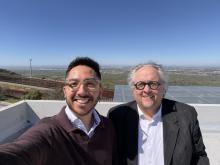
Jesus Raya was invited to present at the 2026 TITO (Tijuana/Torino) International Discussion Seminar on Ontology for Law and Morality: Technology, Borders, and Communities in Tijuana, Mexico. Jesus and Michael Blake posed for a photo at the venue, with the border wall in the background
Rose Sanchez won the Graduate Student Paper Prize in Queer Analytic Philosophy. (The prize is affiliated with the Queer Analytic Philosophy Conference, hosted by UC Santa Cruz.)
Kade Cicchella was awarded a Presidential Dissertation Fellowship in Social Sciences from the Graduate School. This fellowship covers a quarter of pay, benefits, and tuition.
As a department, we are so proud of our Graduate Student's accomplishments and can't wait to see what else they do throughout their time with us!